


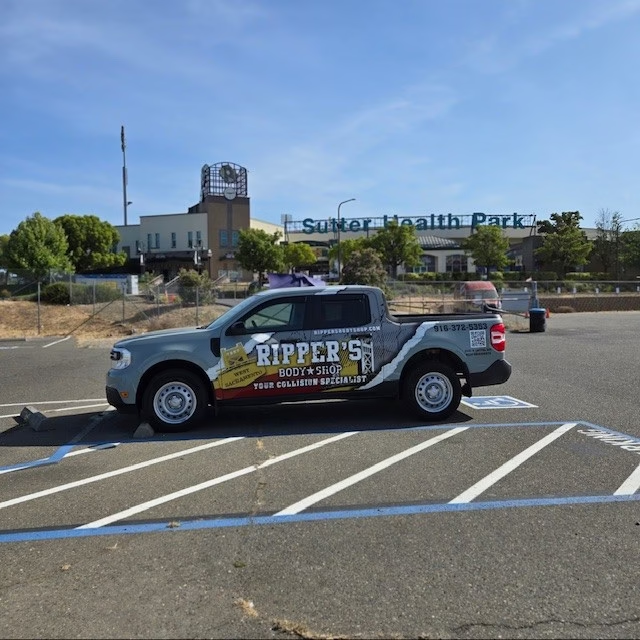
March Series: Expert Tips for Sacramento Drivers
The Resale Value Logic: Why Unrepaired Body Damage Costs Sacramento Drivers Thousands
I’m Frank Maldonado, owner of Rippers Body Shop here in West Sacramento on W Capitol Ave. This March, I’ve been writing a series to help Sacramento-area drivers navigate the situations nobody really prepares you for — what to do right after a collision, how to protect yourself when dealing with insurance companies, and how our Sacramento climate quietly damages your vehicle over time.
In Post #1, I walked you through exactly what to do after an accident, step by step. In Post #2, I explained your legal right to choose your own repair shop — a right too many Sacramento drivers unknowingly sign away. And in Post #3, I covered how our valley heat, UV exposure, and dust affect your vehicle in ways you might not notice until it’s too late.
Today, I want to talk about money. Specifically, the money you’re quietly losing every single day you drive around with unrepaired body damage — and the math that makes auto body repair resale value in Sacramento a smart financial decision, not just a cosmetic one.
Here’s the bottom line: every dent, scratch, faded panel, and cracked bumper on your vehicle is a direct reduction in what someone will pay you for it. And in almost every case, the cost of professional repair is a fraction of the resale value you’d otherwise lose. Let me show you the math.
Section 01: Why Does Body Damage Lower Your Car’s Resale Value in Sacramento?
Body damage lowers resale value because buyers and dealers immediately discount vehicles with visible exterior damage — factoring in their own repair costs before making any offer. According to NADA research, even minor cosmetic damage reduces a vehicle’s pre-accident value by 10–15%. On a $25,000 vehicle, that’s $2,500–$3,750 walking out the door before negotiations even begin.
Sacramento’s used car market has its own dynamics that make this even more important to understand. Our regional prices already run 5–10% below what you’d get selling the same vehicle in Los Angeles or the Bay Area. The average vehicle sits on the market about 26 days here — which means competition is real. When a buyer in Elk Grove or Rancho Cordova is choosing between two comparable vehicles, exterior condition is often the deciding factor. One clean vehicle and one with a dented quarter panel? The clean car wins, almost every time.
What Buyers See in the First 30 Seconds
Most people don’t consciously know what they’re looking for when they walk around a used car. But their instincts do. Within 30 seconds of stepping out of their car in a driveway off I-80 or pulling into a dealer lot in Citrus Heights, a buyer forms an impression. Visible dents, scratches, mismatched paint, or cloudy headlights register immediately — even if the buyer can’t articulate exactly what’s wrong.
That impression drives the negotiation. Buyers who spot exterior damage start mentally calculating what it will cost to fix, then deduct that from their offer. Dealers do the same thing, but with professional efficiency — they’ve seen thousands of vehicles and they know exactly what each damage point is going to cost them.
The Psychology: One-Third of Buyers Walk Away Entirely
Here’s a number that should get your attention: up to 33% of buyers walk away from any vehicle with a documented accident history — regardless of how well it was repaired. That’s from buyer behavior data across used car transactions. So even if your collision damage was professionally repaired, an accident on your CarFax report reduces your buyer pool by roughly a third before anyone even looks at the car.
This is why the quality of the repair — not just whether the repair was done — matters so much. A well-documented, professional repair using quality parts can preserve your value and reassure buyers. A cheap, rushed repair with mismatched paint and visible panel gaps tells a different story entirely.
Typical resale value reduction from visible body damage, even on minor cosmetic issues (NADA research)
Section 02: What Does Unrepaired Body Damage Actually Cost You at Resale Time?
Unrepaired body damage costs Sacramento drivers far more than the repair itself — typically 2 to 5 times the repair cost in lost resale value. A small dent that costs $150 to fix via paintless dent repair (PDR) can reduce your vehicle’s value by $500–$2,000 if left alone. The longer damage sits unaddressed, the more it compounds through rust, oxidation, and structural spread.
I want to show you exactly what this looks like across the most common damage types we see here at the shop. These numbers are based on industry research and our hands-on experience repairing vehicles for Sacramento County and Yolo County drivers over the years.
Damage-by-Damage Cost Comparison
| Damage Type | Estimated Repair Cost | Resale Value Reduction (Unrepaired) | Repair ROI |
|---|---|---|---|
| Small dents (door dings) | $75–$200 (PDR) | $500–$2,000 (5–10%) | 2.5×–10× |
| Moderate dents (parking lot) | $200–$600 | $1,000–$3,000 (5–15%) | 2×–5× |
| Paint scratches (surface) | $150–$300 | $500–$1,500 (5–10%) | 2×–5× |
| Deep scratches / paint chips | $400–$1,000 | $1,500–$3,000 (10–15%) | 2×–3× |
| Bumper damage | $300–$1,500 | $1,500–$4,000 (10–15%) | 2×–3× |
| Faded / oxidized paint | $200–$600 (correction) | $1,000–$3,000 (5–10%) | 2×–5× |
| Yellowed headlights | $75–$150 (restoration) | $300–$1,000 (3–5%) | 2×–7× |
| Cracked dashboard (UV) | $400–$1,500 | $500–$2,000 (5–10%) | 1×–1.5× |
| Mismatched paint (bad repair) | $500–$1,200 (redo) | $2,000–$5,000 (10–20%) | 2×–4× |
| Frame damage (disclosed) | $2,000–$6,000+ | $4,000–$10,000+ (25–30%) | 1.5×–2× |
Resale value reduction percentages based on a $25,000 vehicle (approximate Sacramento market average). Repair ROI reflects value preserved relative to repair cost.
The Compounding Problem: Small Damage Gets Expensive Fast
The damage types with the highest ROI — door dings, surface scratches, headlight restoration — are also the ones most drivers put off. They’re “minor.” They’ll get to it eventually. But here’s what I see at the shop week after week: a $200 paintless dent repair that was ignored for 18 months is now a $2,000+ panel replacement because the paint seal broke, moisture got in, and rust has been working quietly underneath the surface.
California vehicles have a well-earned advantage over out-of-state cars — no road salt means far less rust formation under normal conditions. But that advantage disappears the moment a paint breach goes unaddressed. Once water gets to bare metal, the Sacramento valley heat accelerates oxidation faster than most people realize.
UV Damage Ties Into the Bigger Picture
In Post #3 on Sacramento spring car care, I wrote about how our intense valley sun — up to 300 days of sunshine annually — accelerates paint oxidation, fades interior surfaces, and yellows headlights. That same UV damage shows up on every dealer’s assessment checklist. A cracked dashboard alone can cost you $500–$2,000 in resale value, while the restoration costs far less. Headlight restoration is one of the highest-ROI repairs you can do before selling: $75–$150 in cost, $300–$1,000 in value preserved.
Average resale value loss on a $25,000 Sacramento vehicle with unrepaired collision damage from a fender bender
Section 03: What Do Sacramento Dealers and Private Buyers Actually Check?
Dealers and serious private buyers run a systematic check on every used vehicle — exterior walk-around, paint consistency inspection, panel gap assessment, and a full vehicle history pull through CarFax or AutoCheck. This process takes less than five minutes and can reduce a trade-in offer by 15–25% if they find documented accident history or visible signs of repair.
Dents & Panel Gaps
Appraisers walk each panel at eye level, checking for any surface that doesn’t sit flush. Doors, hoods, and trunk lids that don’t align signal frame or structural repair history.
Paint Color & Texture
Panels that don’t quite match the others under different lighting, or orange-peel texture from a low-quality respray, are spotted immediately by trained appraisers.
Headlight Clarity
Yellowed or hazy headlights signal neglect and UV exposure. They’re a fast deduction point — and one of the easiest, highest-ROI fixes you can make before selling.
CarFax & AutoCheck
Accident history follows your car forever. The average retail price hit from an accident report is about $500 — jumping to $1,700–$2,100 for severe damage history. Clean-history vehicles sell for 15–20% more.
Parts Quality Signals
Mismatched panel texture, paint that shifts in certain lighting, or aftermarket parts that don’t fit as precisely as OEM — these are the details dealers use to reduce trade-in offers. As I covered in Post #2 on insurance rights, choosing your own quality shop protects you here.
Bumper Alignment
Gaps or misalignment in bumper fitment indicate prior impact. Even a minor rear impact that was poorly repaired shows up here and becomes a line-item deduction on your trade-in offer.
Percentage of buyers who walk away from any vehicle with documented accident history, regardless of repair quality
Section 04: Do OEM or Aftermarket Parts Affect Your Car’s Resale Value?
Yes — significantly. Industry data shows that OEM (Original Equipment Manufacturer) parts preserve 85–90% of a vehicle’s pre-accident value, while aftermarket parts retain only 70–75%. Vehicles with documented aftermarket parts can receive 5–10% lower trade-in offers from dealers who recognize the difference during their inspection.
OEM vs. Aftermarket: The Resale Value Gap
- ✓ OEM parts: preserve 85–90% of pre-accident value — nearly factory condition
- ✓ Aftermarket parts: retain only 70–75% of pre-accident value
- ✓ Trade-in impact: documented aftermarket parts = 5–10% lower dealer offers
- ✓ Your right: California law lets you specify OEM parts — see Post #2 for how to exercise it
What the Difference Looks Like in Practice
OEM parts are manufactured to the exact specifications of your vehicle — same tolerances, same materials, same fit. When a door panel, bumper cover, or quarter panel is replaced with an OEM part and properly painted, the result is nearly indistinguishable from factory condition. That matters enormously to buyers and appraisers.
Aftermarket parts are often close — but not exact. The fit is slightly off. The panel gaps aren’t quite right. The paint doesn’t always hold the same way. These differences are visible to a dealer appraiser who inspects dozens of vehicles every week. And they become a line-item reduction on your trade-in offer.
Your Right to Choose Protects Your Resale Value
This is exactly why your right to choose your own body shop — which I covered in detail in Post #2 — is also a financial decision, not just a preference. California law gives you the right to take your vehicle to the shop of your choice after an accident. When you exercise that right and choose a shop that prioritizes OEM or OEM-equivalent parts, you’re protecting not just the quality of the repair but the long-term resale value of your vehicle.
At Rippers Body Shop, we use OEM or OEM-equivalent parts on every repair. We do this because it’s the right way to do the job — and because our customers deserve repairs that hold their value. When you pick up your vehicle from us, it should be as close to pre-accident condition as possible. That’s what protects your investment.
Section 05: The Repair ROI Decision — When Should You Fix It, and When Should You Sell As-Is?
Professional body repair almost always delivers a positive return on investment for vehicles under 8 years old or under 100,000 miles. A good rule of thumb: if the repair cost is less than 50% of the resale value you’d recover, repair it. For older, higher-mileage vehicles, the math is more nuanced — and I’ll walk you through it honestly.
Frank’s Honest Take
As a shop owner, I could tell you to fix everything on every vehicle, every time. That would be good for my business. But that’s not how I operate, and it’s not what I’d tell a neighbor over the fence on a Saturday morning in West Sacramento.
Here’s the truth: not every repair makes financial sense. The decision depends on your vehicle’s age, mileage, overall condition, and what the local market will bear. My job is to help you make an informed decision — not to sell you a repair you don’t need.
The General Rules of Thumb
- 1
Repair cost < 50% of resale value recovered → repair it.
If a $600 bumper repair preserves $1,500–$2,000 in resale value, the math is obvious. Do the repair.
- 2
Vehicles under 8 years old / under 100,000 miles → almost always worth repairing.
These vehicles have significant market value remaining. Buyers and dealers for this segment are pickier, and condition premiums are largest. Every cosmetic issue costs you real money.
- 3
Vehicles over 15 years old / over 200,000 miles → case by case.
At this point, the vehicle’s value is lower overall, and repair costs may approach or exceed value recovery. We assess these together based on your specific situation.
- 4
Multiple damage points → get a full assessment first.
Sometimes bundling repairs is significantly more cost-effective than addressing each item individually. A full assessment lets us identify which repairs deliver the most ROI and which ones you can skip.
Real-World Examples with the Numbers
- 1
Door ding on a 2021 Honda Accord (West Sacramento)
Your neighbor opens their door into yours in a parking lot on Capitol Avenue. You have a 3-inch dent with no paint damage. PDR repair: $150. Resale value reduction if left unrepaired: $800–$1,500 (plus rust risk if paint cracks). ROI: 5×–10×. Fix it.
- 2
Rear bumper scrape on a 2019 Toyota RAV4 (Rancho Cordova)
Backed into a post at a Rancho Cordova shopping center. Cracked and scraped bumper cover. Repair cost: $800–$1,200. Resale value reduction without repair: $2,000–$3,500. ROI: 2×–3×. Fix it.
- 3
Fender bender on a 2022 Ford F-150 (Elk Grove)
Minor collision damage on the front quarter panel and hood. Repair cost: $2,000. Resale value reduction on a $45,000 truck if left unrepaired: $4,000–$6,000. Accident on CarFax will already cost $500–$2,100 in perceived value. Fix the physical damage; at least you control that part of the equation.
- 4
Surface rust and faded paint on a 2010 Chevrolet Silverado (Davis)
Older truck, 175,000 miles, but solid mechanically. Paint correction: $400–$600. Value recovery: $800–$1,500 depending on buyer. Given the mileage, you’re in the case-by-case zone. A free estimate and honest conversation about your goals (sell privately vs. trade-in) will tell us the right answer.
The bottom line: the 25% of owners with damaged vehicles who sell within one year of an accident often leave thousands on the table by not getting a professional assessment first. A free estimate costs nothing. The math might surprise you.
Typical return on investment from professional body repair at resale time — for every dollar spent, you preserve 2–5 dollars in vehicle value
Pro Tip From Frank: Document Everything — It’s Worth 15–20% More at Resale
Keep every repair receipt, photo, and insurance document related to your vehicle. Industry data shows that vehicles with complete repair documentation sell for 15–20% more than those without records. Buyers and dealers respond to proof — a folder showing professional repairs, quality parts, and a maintained vehicle history signals that you’ve taken care of the investment.
When you bring your car to Rippers Body Shop, we provide detailed repair documentation for every job we do. That paperwork protects your vehicle’s resale value for years after you leave our shop. It’s one of the things that separates us from shops that hand you back your keys and nothing else.
You can also cross-reference your accident documentation from our accident response guide — photos taken at the scene, insurance reports, and repair records together create a complete, defensible vehicle history that commands top dollar.
Why Sacramento Drivers Choose Rippers Body Shop for Their Resale Value Repairs
When you bring your vehicle to Rippers, you’re not just getting a repair — you’re making a financial decision to protect your vehicle’s value.
I’m Frank Maldonado. I live and work here in West Sacramento, and I’ve built this shop on honest assessments and quality work.
Don’t let your insurance company dictate where your car gets repaired. We handle the paperwork so you get the shop you choose.
I’ll tell you exactly what you’re looking at: repair costs, resale value impact, and whether the math makes sense for your situation.
Every repair we do is built to preserve your vehicle’s value — parts that produce results that hold up at the shop and at resale time.
Our work is guaranteed. Every job comes with detailed documentation that protects your investment for years.
Sacramento, West Sacramento, Davis, Woodland, Elk Grove, Rancho Cordova, Citrus Heights, and surrounding communities across Sacramento County and Yolo County.
Rippers Body Shop
2435 W Capitol Ave, Suite E — West Sacramento, CA 95691
(916) 372-5353 | info@rippersbodyshops.com | rippersbodyshops.com
FAQ: Auto Body Repair and Resale Value in Sacramento
Frequently asked questions about unrepaired body damage and vehicle resale value — answered by Frank Maldonado, Rippers Body Shop.
Yes — visible dents, scratches, and paint damage typically reduce a vehicle’s resale value by 5–15%, depending on severity and location. On a $25,000 vehicle, that’s $1,250–$3,750 in lost value. Dealers reduce trade-in offers by 10–15% for vehicles with visible cosmetic damage because they factor in their own repair costs before reselling. Professional repair before selling almost always costs less than the resale value you’d otherwise lose.
Small door dings can reduce resale value by $500–$2,000, while moderate parking lot dents can cost $1,000–$3,000 in resale value. Professional paintless dent repair (PDR) typically costs $75–$600 — a fraction of the value it preserves. Studies show professional dent repair returns 2–5× the repair cost at resale time. The key is addressing dents before rust develops; a $200 repair left unfixed can escalate to $2,000+ once paint deteriorates and corrosion sets in.
In most cases, yes — especially if your vehicle is under 8 years old or under 100,000 miles. Sacramento’s used car market runs 5–10% below LA and Bay Area prices, so maximizing your vehicle’s condition is essential to getting top dollar locally. The general rule: if the repair cost is less than 50% of the resale value you’d recover, it’s worth fixing. Rippers Body Shop offers free estimates so you can make an informed decision before spending anything.
Yes. According to CarFax data, the average retail price hit from an accident report is about $500, jumping to $1,700–$2,100 for severe damage history. Vehicles with clean history reports sell for 15–20% more than those with documented accidents. However, the quality of the repair matters significantly — a properly repaired vehicle with OEM parts and professional documentation retains far more value than one with visible signs of cheap repair work.
Industry data shows OEM parts preserve 85–90% of a vehicle’s pre-accident value, while aftermarket parts retain only 70–75%. Vehicles with documented aftermarket parts can receive 5–10% lower trade-in offers from dealers. This is one reason California law gives you the right to choose your own body shop — as we covered in our insurance rights guide. At Rippers Body Shop, we prioritize OEM and OEM-equivalent parts because they protect your vehicle’s long-term value.
Dealers perform a rapid exterior walk-around in the first 30 seconds, checking for dents, scratches, paint inconsistencies, panel gaps, and headlight clarity. They then pull a vehicle history report (CarFax or AutoCheck) to check for accident records. Dealerships typically offer 15–25% less for vehicles with accident history on trade-ins, and they mentally deduct estimated repair costs from any visible damage. This is why addressing cosmetic issues before a trade-in evaluation consistently results in higher offers.
The highest-ROI repairs before selling are: headlight restoration ($75–$150 cost, $300–$1,000 value preserved), paintless dent repair for door dings ($75–$200 cost, $500–$2,000 value preserved), and paint touch-up for chips and scratches ($150–$300 cost, $500–$1,500 value preserved). These small repairs deliver 2–7× return on investment. Bumper repair and paint correction also offer strong ROI at 2–3× return. At Rippers, we can assess all damage points together and help you prioritize the repairs that deliver the most value.
Rippers Body Shop at 2435 W Capitol Ave, Suite E in West Sacramento offers free, no-obligation estimates for all collision repair, dent repair, paint repair, and body restoration. We’ll assess every damage point on your vehicle and help you understand the repair-vs-resale math. We work with all major insurance companies and serve Sacramento, West Sacramento, Davis, Woodland, Elk Grove, Rancho Cordova, Citrus Heights, and surrounding communities across Sacramento County and Yolo County. Call (916) 372-5353 or visit rippersbodyshops.com to schedule your free estimate.
Stay Informed: Get Expert Tips for Sacramento Drivers Every Month
This post is part of our March 2026 series, Expert Tips for Sacramento Drivers — a five-part guide to everything Sacramento drivers need to know about collisions, insurance, climate maintenance, resale value, and roadside safety. If you’ve found this post useful, I’d encourage you to read the rest of the series:
Post #1: What to Do After a Car Accident in West Sacramento
The step-by-step guide for the moments right after a collision — documentation, insurance, and protecting your rights from minute one.
Read Post #1 →Post #2: Your Right to Choose: Insurance Claims Guide
California law gives you the right to pick your own body shop. Here’s how to use that right to get the repair quality your vehicle deserves.
Read Post #2 →Post #3: Sacramento Spring Car Care: Climate-Specific Maintenance
How Sacramento’s heat, UV exposure, and valley dust quietly damage your vehicle — and what to do about it before the damage compounds.
Read Post #3 →Coming Up Next in the Series:
Stranded After an Accident? What Every Sacramento Driver Needs to Know About Safe Towing and Roadside Safety.
Whether it’s a breakdown on I-80 near Davis, a fender bender on Business 80 in the morning commute, or a late-night situation on Highway 50 heading back from Rancho Cordova — knowing what to do and who to call makes all the difference. Post #5 will cover exactly that.
Follow the full series at rippersbodyshops.com.
