


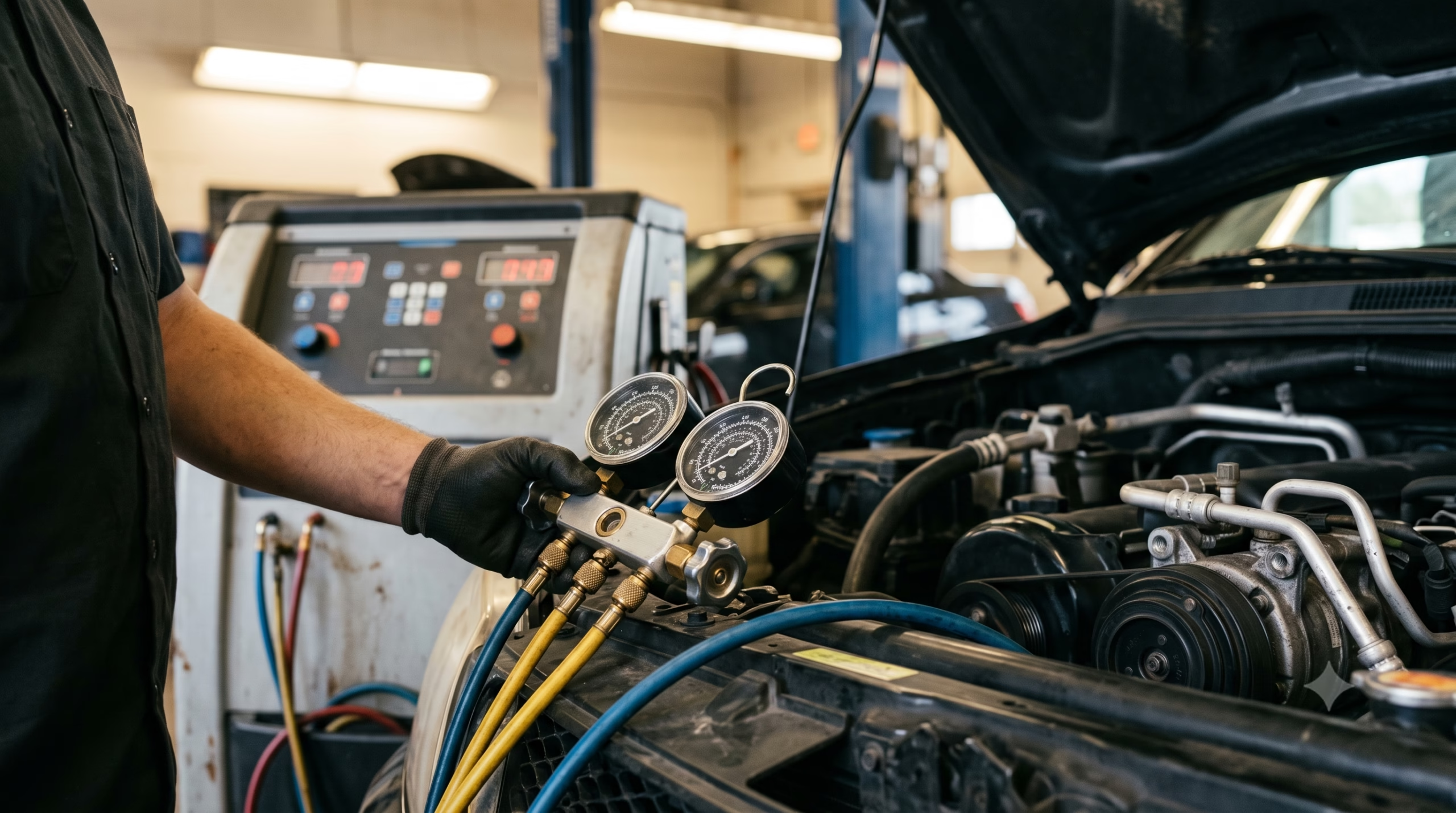
R-134a vs
R-1234yf.
Somewhere between 2013 and 2021, your car's A/C got quietly re-engineered around a completely new refrigerant. Here's the full story on both — and how to identify which one you have in about 60 seconds, before the repair estimate arrives.

For a quarter century, every new car sold in America used the same refrigerant. Then, quietly, the industry swapped it out.
From 1994 until about 2014, if you owned a car in the United States, your A/C system used R-134a. Every make. Every model. One chemistry. Then — over about eight years, and with almost no consumer-facing announcement — the industry transitioned to a completely different refrigerant called R-1234yf. By 2021, the EPA made it federally required on all new vehicles.
The switch was good for the planet, complicated for the auto-parts supply chain, and expensive for anyone whose car needs A/C service on the newer system. Here's the whole story — plus, at the end, the sixty-second check that tells you which refrigerant you have without opening an owner's manual.
Introduced 1994. In every US car for about 20 years. Effective, cheap to make, but a moderately strong greenhouse gas — global warming potential of about 1,430 (versus CO₂'s 1).
Adopted 2013 onward. Federally required 2021. Cools identically to R-134a but with a global warming potential under 1 — roughly equivalent to CO₂, and it breaks down in about 11 days.
Why the industry made the change.
The short answer is greenhouse gas math. R-134a's global warming potential — how much heat it traps in the atmosphere per pound, compared to CO₂ — is about 1,430 times that of an equal amount of carbon dioxide. And once it leaks into the atmosphere, R-134a sticks around for roughly 13 years. Multiplied across hundreds of millions of vehicles worldwide, it added up.
R-1234yf, by comparison, has a global warming potential under 1 — essentially equivalent to CO₂ itself — and it breaks down in the atmosphere in about 11 days. Same cooling performance in the car. Vastly different climate impact.
The transition happened in a mostly non-public series of regulatory dominoes:
- 2006 EU MAC Directive announced. European Union set a 2017 deadline banning high-GWP refrigerants in new cars.
- 2013 First US adoption. The Cadillac XTS became the first US-market car to ship with R-1234yf. Other GM and Chrysler models followed.
- 2014 – 2018 The messy middle. European manufacturers switched quickly; Japanese and Korean makers held out. During this period, the same model year of the same brand could ship with either refrigerant depending on production date.
- 2017 EU deadline hits. All new EU-sold cars must use low-GWP refrigerant.
- 2021 US federal mandate. The EPA's SNAP rule 20 required R-1234yf on all new US vehicles. Every 2021+ US car uses it.
If your car is a 2013 or older model, it almost certainly runs R-134a. If it's a 2021 or newer, it definitely runs R-1234yf. The 2014-2020 range is where it gets interesting — and where the underhood label is your only reliable answer.
Why R-1234yf costs 8 to 10 times more per ounce.
The refrigerant chemistry is the biggest single reason A/C service pricing looks so different depending on which one your car uses. Here's the wholesale reality most drivers never see:
Full recharge, typical car: ~$10-15 in raw refrigerant. Plus labor, gaskets, and evacuation time.
Full recharge, typical car: ~$80-120 in raw refrigerant alone. Plus the same labor, gaskets, and evacuation.
Where the price difference comes from
Three things drive the gap. First, patent economics. R-1234yf is a proprietary molecule jointly developed by Honeywell and Chemours; global production is concentrated in a handful of licensed plants. R-134a's patents expired long ago and dozens of manufacturers produce it. Second, manufacturing complexity. R-1234yf requires a more elaborate synthesis process using more expensive feedstocks. Third, mandatory recovery equipment. Because R-1234yf is classified as mildly flammable (A2L category), shops that service it must use SAE J2843-certified recovery/recycling machines that are more sophisticated and considerably more expensive than R-134a equipment.
Add all three together: the raw material costs about 8-10x more, the equipment to safely handle it costs several times more, and the certification requirements are stricter. That's why an A/C service on a 2022 vehicle is materially more expensive than the same service on a 2012 vehicle — even though both jobs look identical from the outside.
The two refrigerants are not interchangeable — they use different operating pressures, different lubricants, and physically different service port fittings. You literally cannot put R-134a into a R-1234yf system with a standard hose. That's by design.
The sixty-second check to know which refrigerant you have.
There are four ways to identify your car's refrigerant, in descending order of certainty. Every one of them is quick and doesn't require calling anyone.
- 01
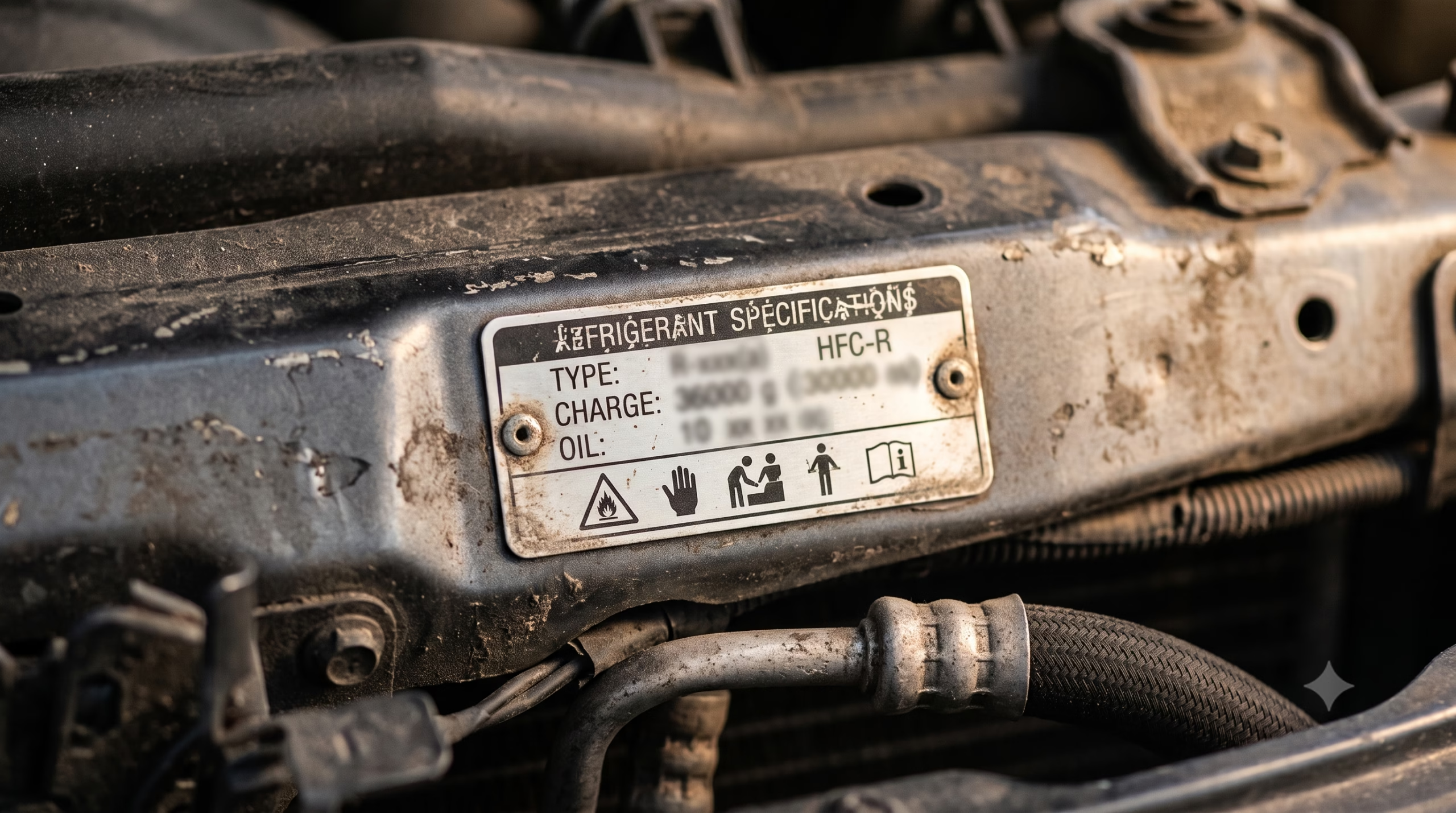
Read the underhood specification label.
This is the definitive answer. Every A/C-equipped vehicle has a small aluminum or laminated label somewhere under the hood — usually on the underside of the hood, on the radiator support, or on the firewall. It states the refrigerant type ("R-134a" or "R-1234yf") and the exact system capacity in ounces or grams. Takes 30 seconds to find and read.
- 02
Check the service port fitting shape.
The two refrigerants use physically different service port fittings that will not accept each other's hoses. R-134a ports are the industry-standard quick-connect fittings that have been around since the mid-1990s. R-1234yf ports are shaped differently — smaller, with a different retention mechanism. If your car has a repair shop's decal or the fitting looks unfamiliar, that's a clue.
- 03
Apply the model year rule of thumb.
Approximately reliable: 2013 and older is almost certainly R-134a. 2021 and newer is federally required to be R-1234yf. 2014 through 2020 is mixed depending on make, model, and production date — this is when the underhood label matters most.
- 04
Check the owner's manual.
Look under "Fluid Specifications" or "Air Conditioning." It'll be listed. If you don't have the paper manual, most manufacturers post PDF copies of the owner's manual on their websites — searchable by VIN or model year.
- 2013 & older R-134a — almost certainly. Predates the transition.
- 2014 – 2020 Mixed. GM and Chrysler switched early. Some Toyota and Honda held out. The underhood label is definitive.
- 2021 & newer R-1234yf — federally required. EPA SNAP Rule 20 in effect.
What all this actually costs at the counter.
For a straightforward A/C service — recovery, evacuation, leak check, recharge to spec, system performance verification — the pricing at Rippers this July reflects the refrigerant reality:
- $99 R-134a system. Full service, standard scope. Applies to most vehicles model year 2013 and older, and roughly half the 2014-2020 range.
- $240 R-1234yf system. Same service scope with certified equipment and the more expensive refrigerant. Applies to all 2021+ vehicles and the newer half of 2014-2020.
The important part: we identify which service applies before we do anything. Free intake, we read the underhood label, we quote you the right service, and we don't proceed without your go-ahead. If the diagnostic finds an actual failure — a leak, a bad compressor, a failed condenser — you get a separate written estimate for the repair before any additional work happens.
A/C systems don't lose refrigerant on their own if they're sealed. If your system is low, there's a leak somewhere. A recharge without addressing the leak is temporary. That's why every A/C service at Rippers includes a leak check — it's the difference between a fix and a delay.
Book while it's still July.
The $99 R-134a and $240 R-1234yf service pricing runs through July 31, 2026. Free intake, we identify your refrigerant before quoting, written estimate for anything beyond the base service. Call ahead — July gets busy fast once temperatures cross 100°F.
Book Your A/C Service or call (916) 372-5353Also worth knowing: our July newsletter has the full month of guides plus a new monthly Community Beat section covering West Sacramento news.
More from July.
- Jul 9 · You are here
R-134a vs R-1234yf: The Refrigerant Story
- Jul 16 · Up next
Six Warning Signs Your A/C Is About to Fail
Read July 16 → - Jul 23
Heat, Not Cold, Is What Kills Car Batteries in Sacramento
Read July 23 → - Jul 30
August Is Coming: A Peak-Summer Prep Guide
Read July 30 →
Quick answers, in one sentence each.
How do I know if my car uses R-134a or R-1234yf?
The definitive answer is on the underhood A/C specification label — usually a small aluminum plate on the underside of the hood, radiator support, or firewall — which lists the refrigerant type and system capacity. As a rule of thumb, 2013 and older vehicles use R-134a, 2021 and newer vehicles use R-1234yf per federal EPA mandate, and 2014-2020 vehicles vary by make, model, and production date. The two refrigerants have physically different service port fittings and are not interchangeable.
Why is R-1234yf so much more expensive than R-134a?
R-1234yf costs about 8 to 10 times more per ounce than R-134a — approximately $5.28 per ounce wholesale versus $0.55 for R-134a. Three factors drive the difference: R-1234yf is a patent-protected molecule with limited licensed production capacity worldwide, its manufacturing process is more complex, and the SAE J2843-certified recovery equipment required to service it is significantly more expensive than R-134a equipment.
Can I put R-134a in a R-1234yf system?
No — the two refrigerants are not interchangeable and the service port fittings are physically incompatible so a standard R-134a hose will not connect to a R-1234yf port. The two refrigerants also use different lubricants and different operating pressures. Attempting to mix them can damage the A/C system and violates EPA regulations for refrigerant handling.
When did cars switch from R-134a to R-1234yf?
The transition happened gradually between 2013 and 2021. The 2013 Cadillac XTS was the first US-market vehicle to use R-1234yf, European makers switched by the 2017 EU deadline, and the US EPA's SNAP Rule 20 made R-1234yf federally required on all new US vehicles from the 2021 model year onward. The 2014-2020 range is mixed depending on manufacturer.
How much does an A/C recharge cost in Sacramento?
A basic R-134a A/C recharge in the Sacramento area typically ranges from $99 to $200 depending on system capacity and labor scope; a comparable R-1234yf recharge typically ranges from $240 to $500. Rippers Body Shop is running a July 2026 promotional special at $99 for R-134a service and $240 for R-1234yf service, both covering full evacuation, leak check, and recharge to specification. Systems with active leaks or component failures require additional diagnostic and repair work.
CA BAR Automotive Repair Dealer Reg. ARD #294466
A/C service pricing is a promotional special valid through July 31, 2026, on standard service scope for the indicated refrigerant type. Systems with active leaks, failed components, or contaminated refrigerant may require additional service; free written estimate provided before any additional work. All services are customer-pay only. Refrigerant identification is definitive per the underhood A/C specification label, which we verify at intake. Global warming potential and atmospheric lifetime figures cited from IPCC AR5 metrics and EPA references. See the rest of the series and our July 2026 newsletter for more.